


Page 168 - Keubler Motion Sensors
P. 168
Absolute encoders - singleturn


          Compact
          magnetic                        Sendix M3658 / M3678 (shaft / hollow shaft)  SAE J1939
        www.HydroSanatSharif.com
         Interface characteristics CANopen
         Resolution                1 ... 16384 (14 bit), scalable
                                   default: 16384 (14 bit)
         Code                      binary
         Interface                 CAN high-speed acc. to ISO 11898,
                                   Basic- and Full-CAN,
                                   CAN specification 2.0 B
         Protocol                  SAE J1939
         Node address              1 ... 255
                                   via address claiming
         Baud rate                 250 kbit/s
         Termination               software configurable


         General information concerning SAE J1939           Encoder implementation SAE J1939
         The protocol J1939 originates from the international Society of Automotive   •   PGNs that are adaptable to the customer’s application.
         Engineers (SAE) and operates on the physical layer with high speed CAN as   •   Resolution of address conflicts -> Address Claiming (ACL).
         per ISO11898. The application emphasis lies in the area of the power train
         and chassis of commercial vehicles. It serves to transfer diagnostic data (for   •   Continuous checking whether control addresses have been assigned twice
         example, motor speed, position, temperature) and control information. Type     within a network.
         series M3658 and M3678 encoders support the total functionality of J1939.   •   Change of control device addresses during run-time.
         This protocol is a multimaster system with decentralised network management   •   Unique identification of a control device with the help of a name that is
         that does not involve channel-based communication.    unique worldwide. This name serves to identify the functionality of a control
                                                              device in the network.
         It supports up to 254 logic nodes and 30 physical control devices per segment.
         The information is described as parameters (signals) and combined on 4   •   Predefined PGs for position, speed and alarm.
         memory pages (data pages) into parameter groups (PGs). Each parameter group   •   250 kbit/s, 29 bit identifier.
         can be identified via a unique number, the parameter group number (PGN).   •   Watchdog controlled device.
         Independently of this, each signal is assigned a unique SPN (suspect parameter
         number).                                           A two-colour LED, located on the rear of the encoder, signals the operating and
                                                            fault status of the J1939 protocol, as well as the status of the internal sensor
         The major part of the communication occurs cyclically and can be received by   diagnostics.
         all control devices without the explicit request for data (Broadcast). Furthermore
         the parameter groups are optimised to a length of 8 data bytes. This enables
         very efficient utilization of the CAN protocol. If greater amounts of data need
         to be transferred, then transport protocols (TP) can be used: BAM (broadcast
         announce message) and CMDT (connection mode data transfer). With BAM TP
         the transfer of data occurs as a broadcast.


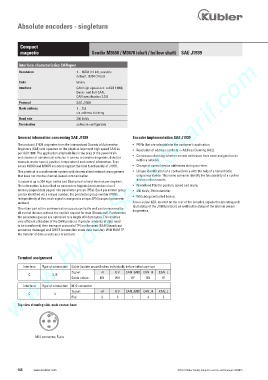
         Terminal assignment
            Interface    Type of connection   Cable (isolate unused wires individually before initial start-up)
                                 Signal:      +V    0 V   CAN_GND  CAN_H   CAN_L
              C         2, B
                                 Cable colour:    BN    WH    GY    GN    YE
            Interface    Type of connection   M12 connector
                                 Signal:      +V    0 V   CAN_GND  CAN_H   CAN_L
              C          4
                                 Pin:         2      3      1      4     5
         Top view of mating side, male contact base

                       2
                    3  5  1
                       4

                 M12 connector, 5-pin


         166    www.kuebler.com                                                 © Fritz Kübler GmbH, subject to errors and changes. 02/2015

