


Page 32 - Keubler Motion Sensors
P. 32
Basics


          Encoders                          Installing encoders


                                           Encoders shafts and in turn their bearings are sub-  Not making use of a coupling but instead rigid-
        www.HydroSanatSharif.com
                                           jected to loads for a variety of reasons:  ly mounting the shaft and the encoder housing
                                           •   Installation tolerances when mounting the       generally leads to unacceptably high loads on the
                                             encoders (radial and angular displacement)  bearings; the ensuing wear will cause the encoder
                                                                             to fail prematurely.
                                           •   Thermal changes, e.g. linear expansion of the
                                             drive shaft                     In order to avoid permanent damage of the encoder,
                                                                             certain bearing loads should not be exceeded. If
                                           •   Effects of wear, e.g. radial runout of the drive
                                             shaft or vibrations             hollow shaft encoders are correctly installed and the
                                                                             torque stops or stator couplings that are available
                                           These load factors have a direct effect on the life   from Kübler are used, then no problems should oc-
                                           expectancy of the shaft bearings and on the quality   cur. For solid shaft encoders the maximum permitted
                                           of the signal.
                                                                             axial and radial loads are shown in the appropriate
                                           Facilities must therefore be provided during   technical data.
                                           installation to compensate for these forces. For
                                           encoders having a solid shaft this is generally done
                                           by using shaft couplings between the drive shaft and
                                           the encoder shaft. The solution with hollow shaft
                                           encoders is to use stator couplings, fixing brackets
                                           or torque stops between the encoder flange and the
                                           mounting surface.


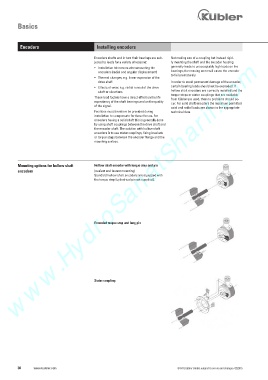
         Mounting options for hollow shaft    Hollow shaft encoder with torque stop and pin
         encoders                          (easiest and fastest mounting)
                                           Standard hollow shaft encoders are equipped with
                                           the torque stop (cylindrical pin not supplied).


                                           Extended torque stop and long pin


                                           Stator coupling


         30     www.kuebler.com                                                 © Fritz Kübler GmbH, subject to errors and changes. 02/2015

